RDMA in gVisor: A Deep Dive into GPU Networking
1. The kernel space, or the OS's core. It manages hardware resources like RAM and CPU.
2. The user-space, which is the home of most user processes. These applications communicate with the OS via system calls (syscalls) to the kernel.
DMA (Direct Memory Access) allows devices like network interface cards (NICs) to directly access RAM1 without copying data through the CPU. The kernel is involved in receiving completion events and propogating them back to the user-space application.
RDMA (Remote Direct Memory Access) extends DMA by allowing one peer to read and write into another peer's memory. Additionally, user-space work and their completions bypass the kernel2, allowing for high-throughput, low-latency communication.
Special networking hardware for RDMA exists that can send up to 800 Gbps of data over the wire. The common physical transports are InfiniBand, which is dominated by NVIDIA-acquired Mellanox, and RoCE (RDMA over Converged Ethernet), which implements InfiniBand semantics on upgraded ethernet hardware3. To allow the user-space direct InfiniBand/RoCE access, applications call
libibverbs via uverbs character devices. 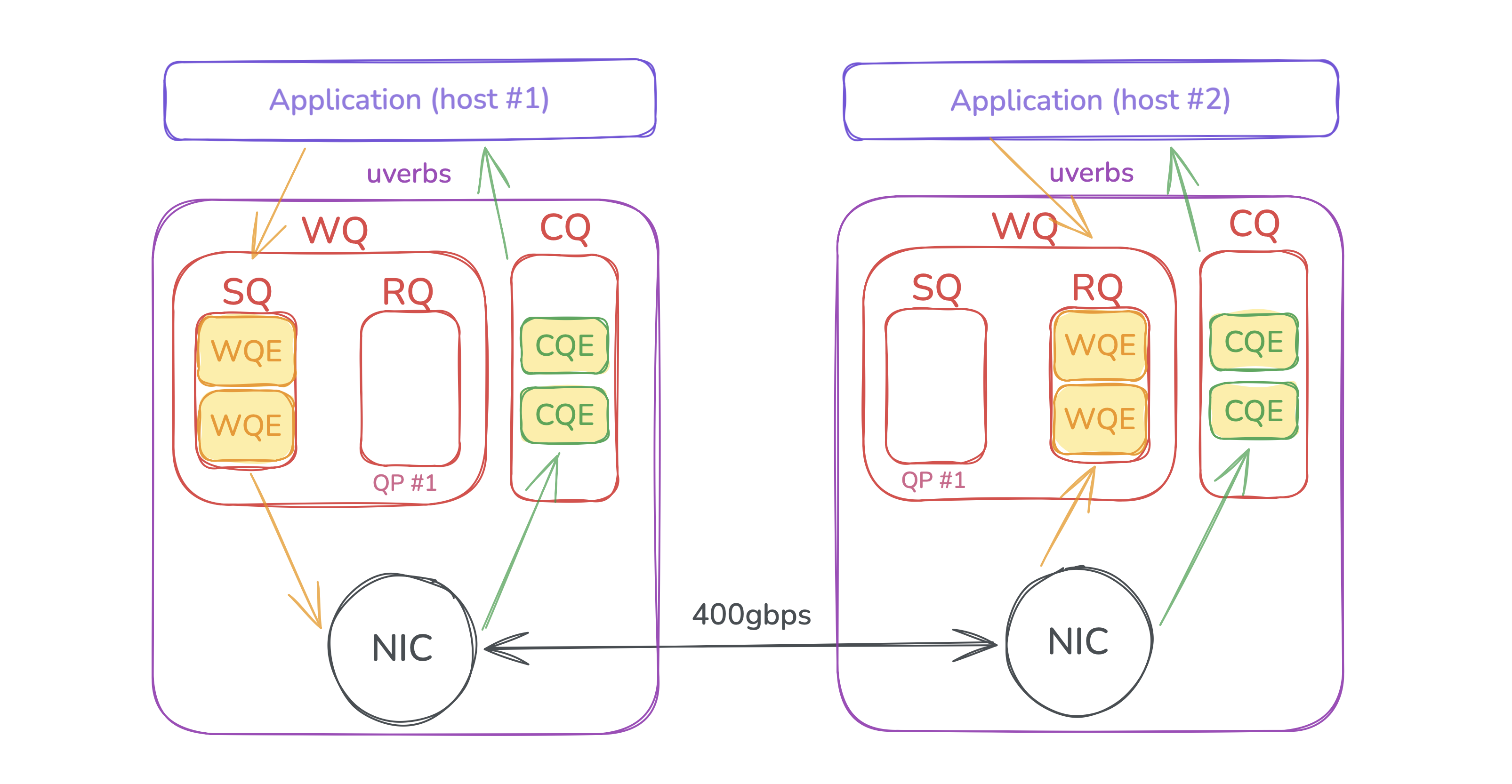
uverbs provides direct access to the NIC hardware. In a RDMA transfer, a work queue element (WQE) is created by the application, the message gets sent over the NIC,
acknowledged by the peer, and propogated back to the application as a completion queue element (CQE). RDMA sets up persistent send queues (SQ) and receive queues (RQ) that together form a queue pair (QP)4.The gVisor Container Runtime
gVisor is a container runtime for sandboxed applications. Containers run user application code as a guest process and intercept all syscalls to the kernel. gVisor traps syscalls and emulates them in a user-space kernel called the Sentry. For example, memory management, networking, and fetching files from the host filesystem (via gofer) are all handled in the Sentry process: nothing has to go directly to the host kernel.Proxies for devices like GPUs are an exception to the emulation rule: they pass syscalls through to the host kernel. For example, a containerized application calls
cudaMemcpy(), which issues an ioctl on a GPU device. gVisor: 1. Traps syscall and routes it to the correct handler based on command number.
2. Translates the application's GPU device file descriptor (FD) to a host GPU device FD.
3. Issues the
ioctl against the kernel and copied the result back out to the application. 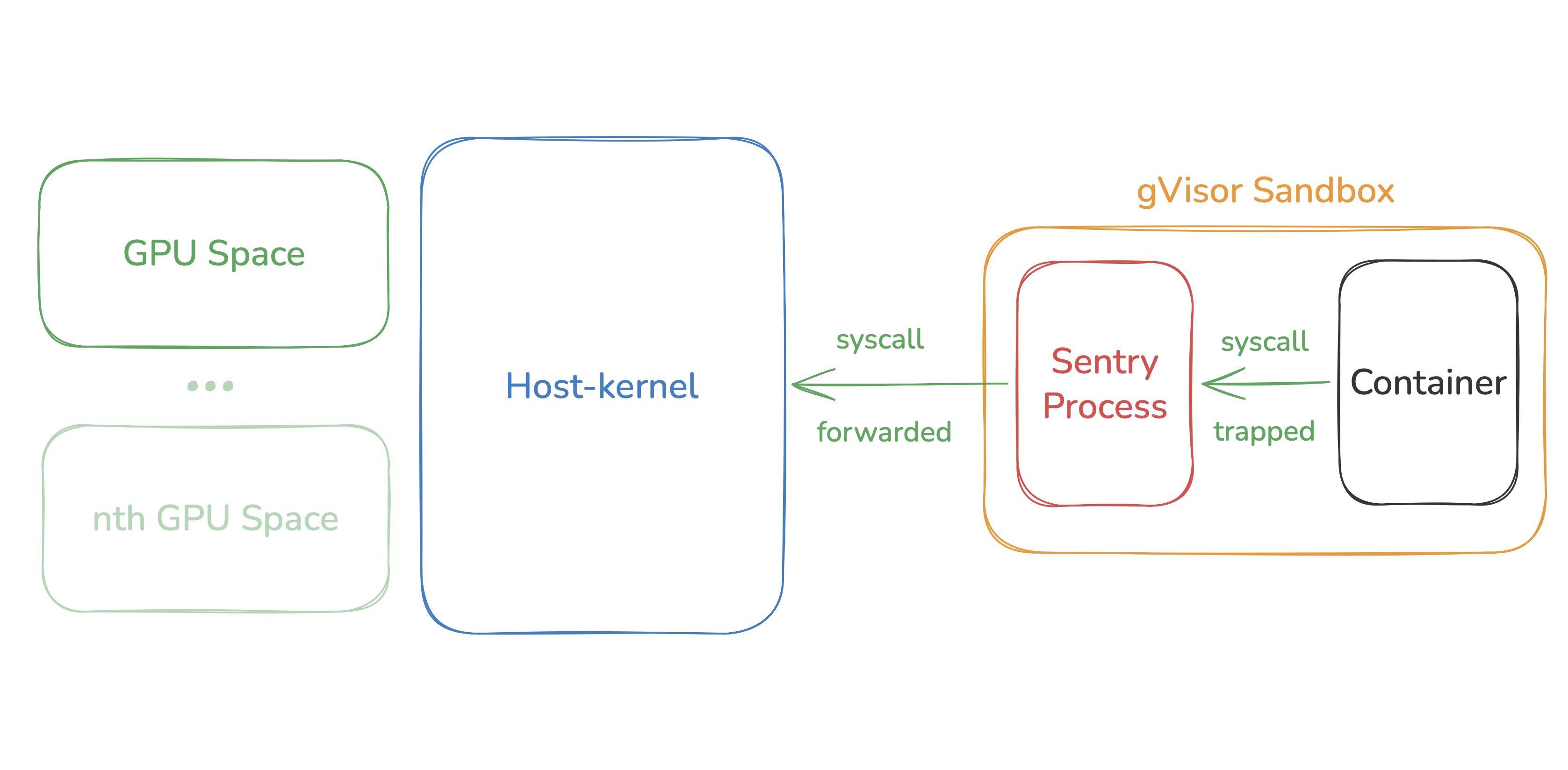
Supporting GPUDirect RDMA in gVisor
Supporting RDMA with InfiniBand is a highly-requested feature. Our target implementation adds aRDMAProxy syscall interface to gVisor and forwards RDMA syscalls through to the host kernel. My goal is to match the peak bandwidth performance of gVisor RDMA to
runc with a 10% margin. runc is a popular container runtime that
lacks the security isolation of gVisor, and all RDMA syscalls work out of the box. In default operation, CUDA applications use GPUDirect RDMA, which allows for true P2P data transfer between GPUs. GPUDirect RDMA skips copying data from CPU to GPU. Instead, the NIC writes its data directly to GPU device memory via a shared PCI bridge between the NIC and GPU. You should see a 10x increase in bandwidth when using this mode of operation.
Memory Registration in RDMA
After a gVisor container receives all information about the host's RDMA hardware, the application registers memory for the data transfer, whether from host or GPU RAM. An RDMA-enabled NIC receives a scatter-gather list containing the physically contiguous regions of memory. The "scatter" comes from how the OS page table works: virtual regions of memory may be scattered across many different physical pages. "Gather" refers to a NIC grouping these physical pages into one logical range for transmission or reception of data.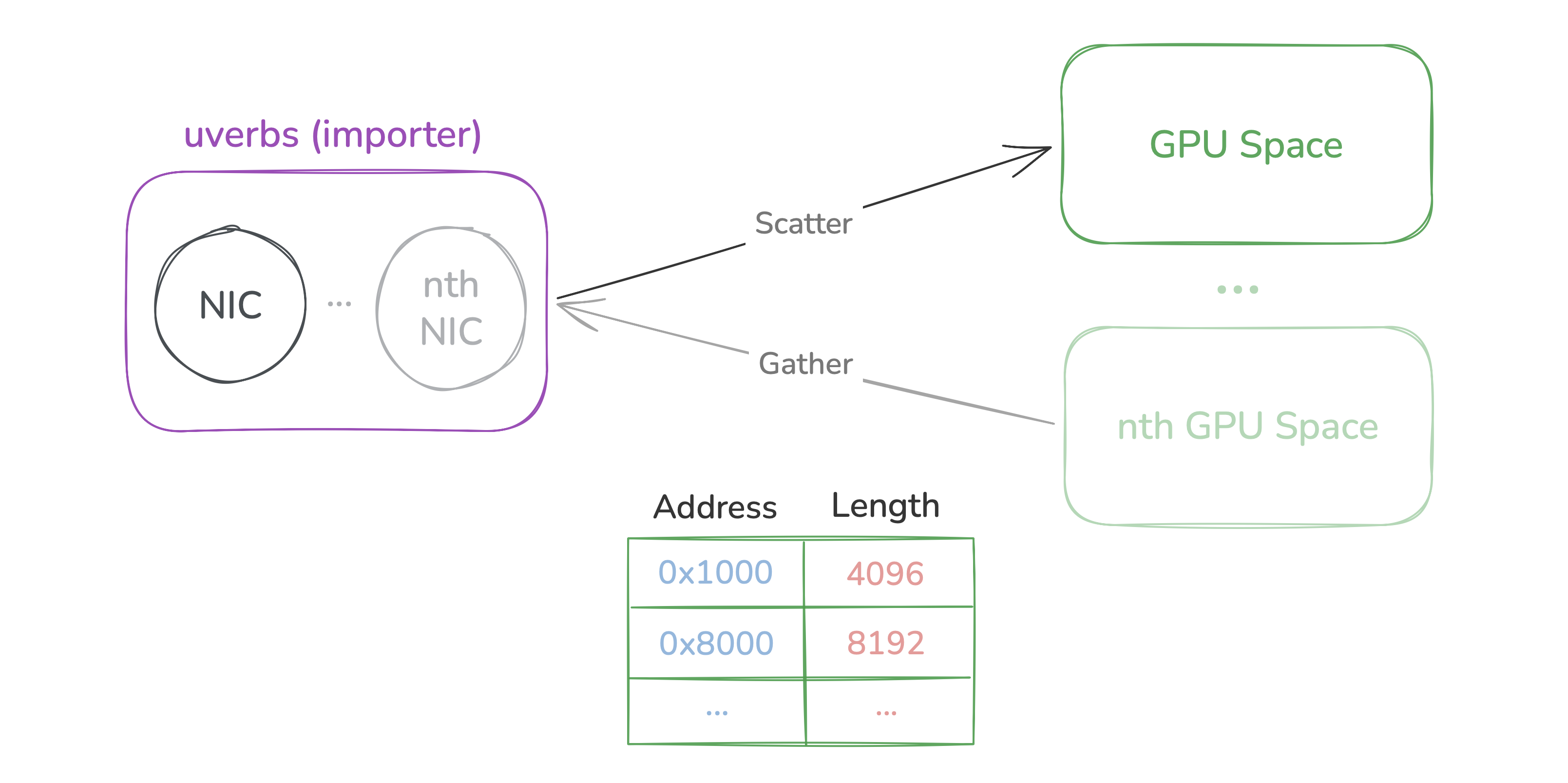
uverbs programs the NIC with a scatter-gather list of
memory regions to be used in RDMA. The scatter-gather list contains virtual addresses and the corresponding length of physically contiguous memory starting at that address5.For gVisor, the RDMA application process picks the virtual address regions it wants to pin,
uverbs receives an ibv_reg_mr() call, and gVisor forwards any ioctl() calls to the kernel-mode RDMA driver. 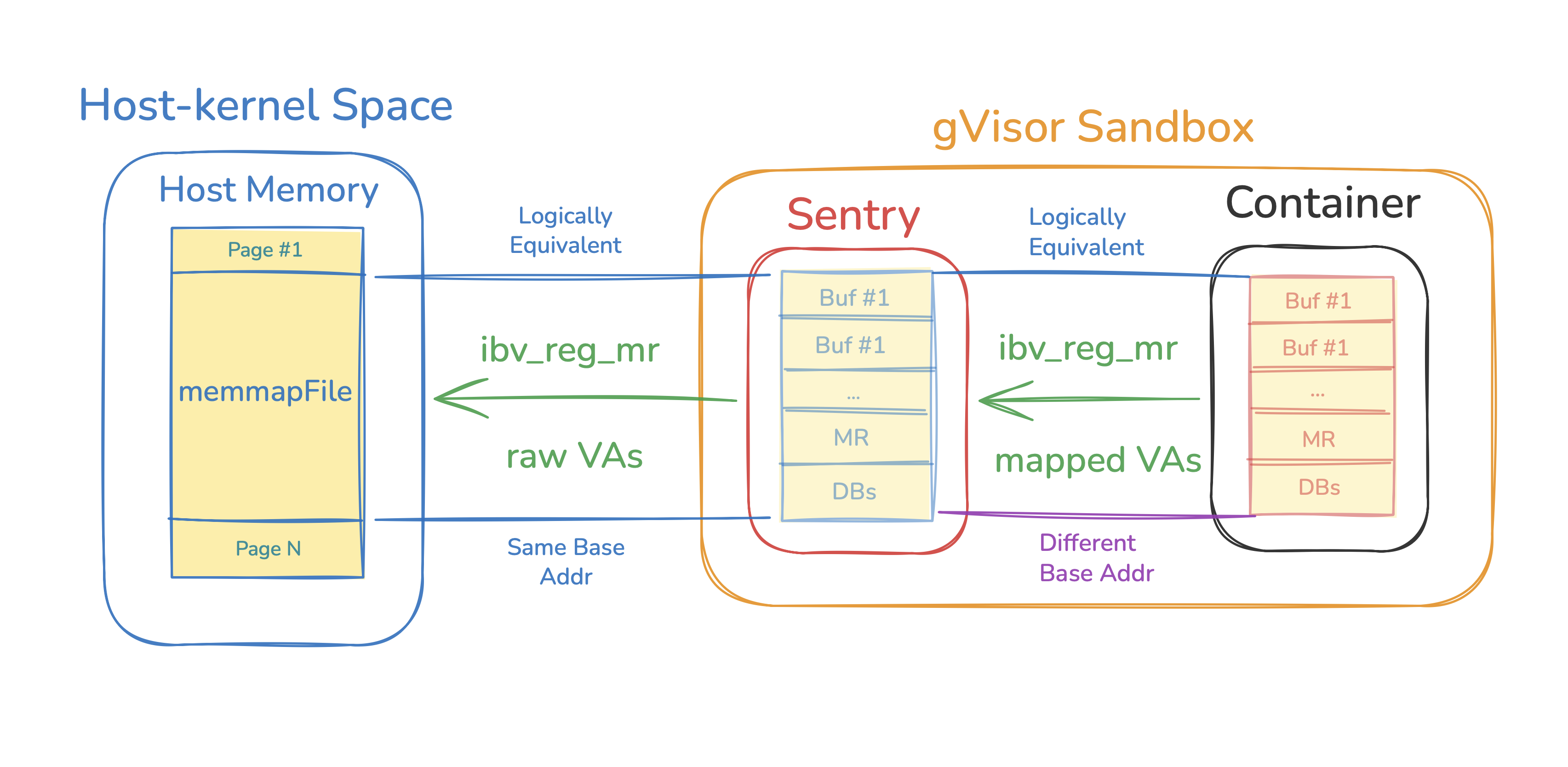
ibv_reg_mr(), but the virtual address can overlap between separate CUDA processes. The sentry now maps process-specific
addresses to a single host address, causing a fatal collision when ibv_reg_mr() gets forwarded to the NVIDIA kernel module.Using DMABUF to Bypass Memory Collisions
In my initial implementation, NCCL gets wedged during memory registration:NCCL Couldn't register memory region with regattr. RC: -14, ERROR: Bad addressIn gVisor, the sentry traps all syscalls and passes them through to the kernel.
ibv_reg_mr() calls from logically different processes get multiplexed into a single process's syscalls, causing a fatal address collision. One solution is to transform the Sentry from a single process architecture to a multi-process architecture, which is a massive rewrite. NVIDIA's main RDMA documentation mentions only a single mechanism, the
nvidia-peermem kernel module, for performing GPUDirect RDMA.
However, I did a little digging into the NCCL environment variables for RDMA and
noticed a second, hidden flavor of GPUDirect RDMA6: DMABUF. DMABUF leverages the existing
dma-buf Linux subsystem for sharing DMA memory between processes. An "exporter" creates the DMABUF object containing a scatter-gather list, and an "importer" receives the file descriptor
pointing to this object. We can create a DMABUF object via the CUDA user-space libcuda.so, receive the object's file handle
upon a successful syscall to the NVIDIA kernel module nvidia.ko, and share the file handle with uverbs, the NIC's RDMA user-interface library. Most importantly,
the DMABUF exporter in NVIDIA's kernel module does not depend on the PID of the calling process, and we can use sentry without rewriting any architecture. 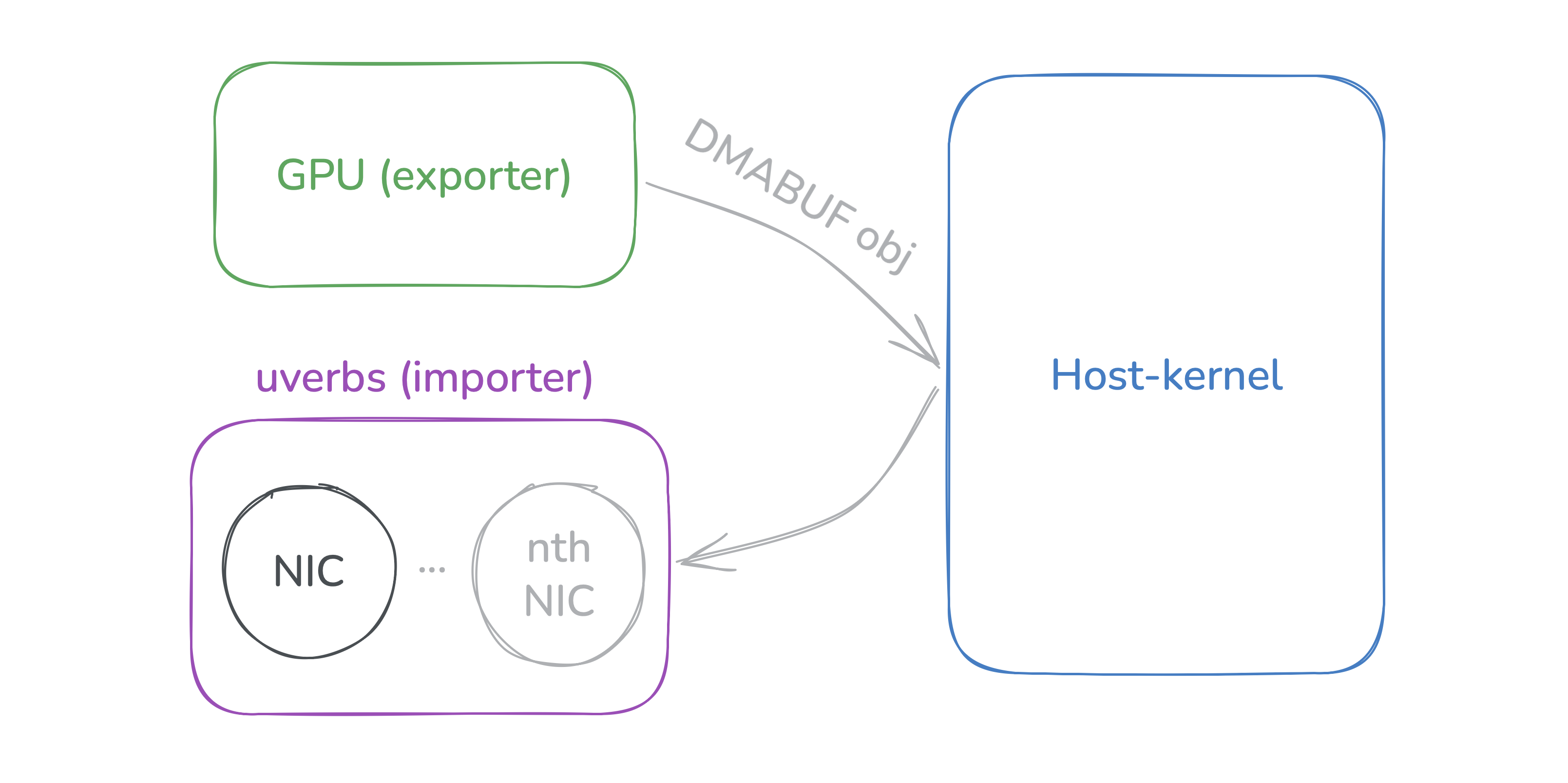
dma-buf subsystem. A file descriptor is shared to the application
and then the uverbs subsystem,
which can import the DMABUF object.Networking Challenges
By default, a container is created in a new network namespace, and the host must move its network interfaces into that new namespace. Two problems result from this:1. Moved interfaces retain the network model of the host's network namespace. Part of the network model decides what interfaces can respond to ARP broadcasts, which is when a host requests a MAC address for a given IP address. For certain cloud providers, the host network model was weak, causing RDMA to fail when a interface tries to setup its queue pair with the wrong device. You can read more about the strange network setting called
arp_ignore that lets any interface answer the ARP request if the target IP is configured somewhere
on the host. 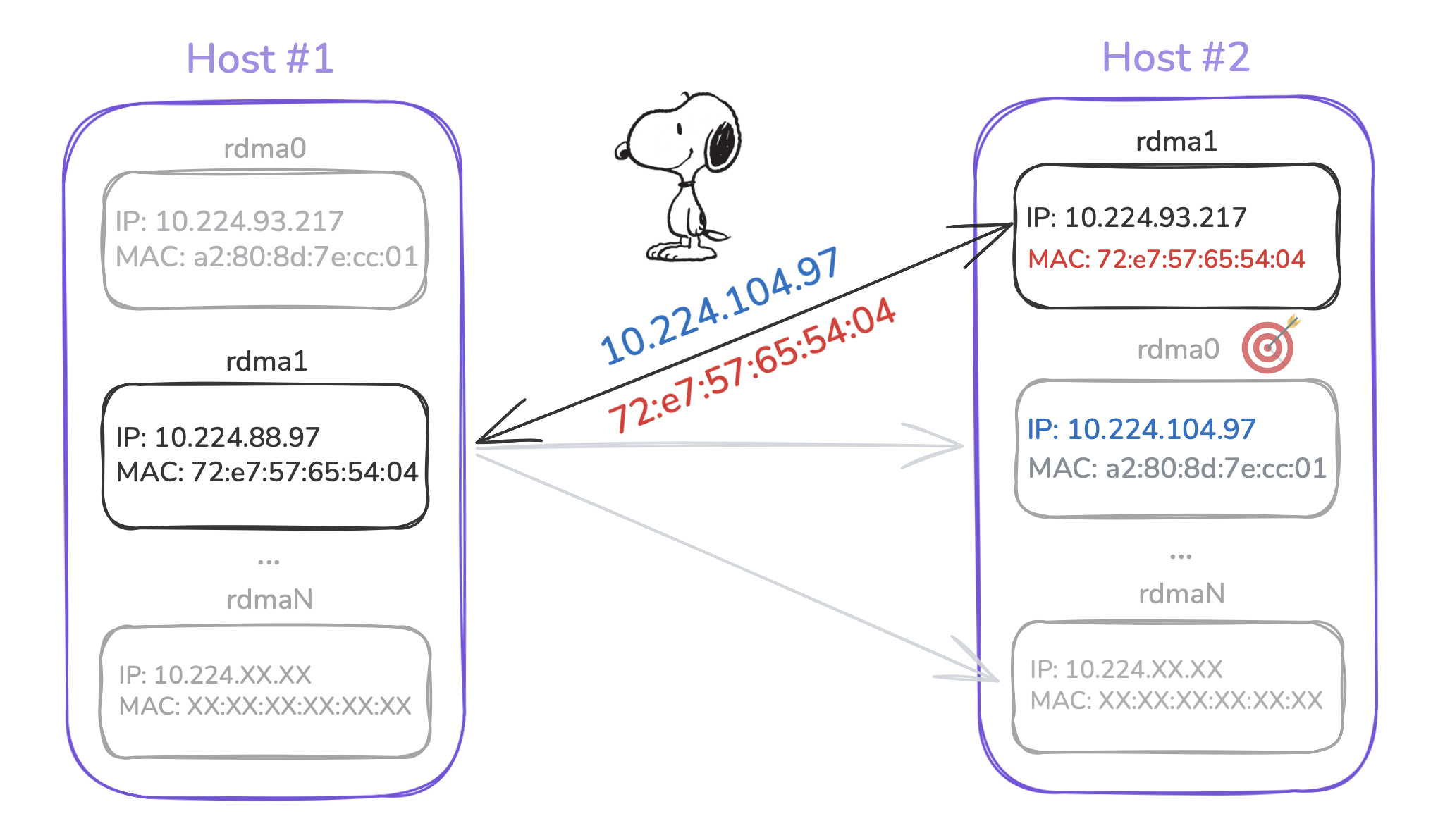
uverbs relies on a GID (Global Identifier), which is a 128-bit number
like an IPv6 address. RoCE relies on the IPv4 addresses of the RDMA network interfaces to populate the device's GID.
A background service, such as the machine vendor's startup process, will
assign static IPs to the interfaces upon boot. When the interfaces are moved out of the host namespace, the kernel clears the IP addresses. Nothing in the container assigns IP addresses to the interfaces, causing GIDs to be unpopulated
and ibv_modify_qp() to fail. Our solution requires manually assigning the IP addresses if a user decides to move RDMA interfaces into the container. The problem was particularly challenging to debug: as IP addresses disappear, moving them back into the host namespace fails to restore them, and your testing nodes are cooked!
Questions
1. How do RDMA and NCCL differ between GPU instance types (e.g. AWS EFA vs Mellanox, Blackwell vs Hopper, IPoIB vs RoCE)?EFA resembles InfiniBand
uverbs devices but uses Amazon's custom RDMA provider implementation. The whitepaper discusses preventing head-of-line delays by allowing messages to arrive out-of-order, which reduces congestion for large AWS datacenters. Since the EFA interface is quite similar to InfiniBand, replicating the syscall shim was easy except for a few issues with the
aws-ofi-nccl plugin. AWS only started allowing DMABUF two months before this post, and my image's NCCL version pre-dated the release that removed the feature gate. Next, the kernel version gVisor presents was gated by the plugin, but hard-coding a version >= 5.12 fixed the issue. Regarding GPU architecture, Blackwell chips are shipped with 2x higher bandwidth networking cards than Hopper chips. NCCL support is quite fragile for B200s, but setting
NVIDIA_CUMEM_ENABLE=0 seems to pop the bubbles. Most cloud providers are using RoCE with their NVIDIA chips, and InfiniBand consumers set IPoIB inactive for their virtual machines.
2. What is the length of a RDMA transfer? How often does memory registration occur?
For a single all-reduce operation, the RDMA setup happens once upfront and NCCL can reuse this setup for multiple collective operations. Below, I am running a multi-node benchmark on an all-reduce operation transferring 4.0 GB of data over 50 trials.
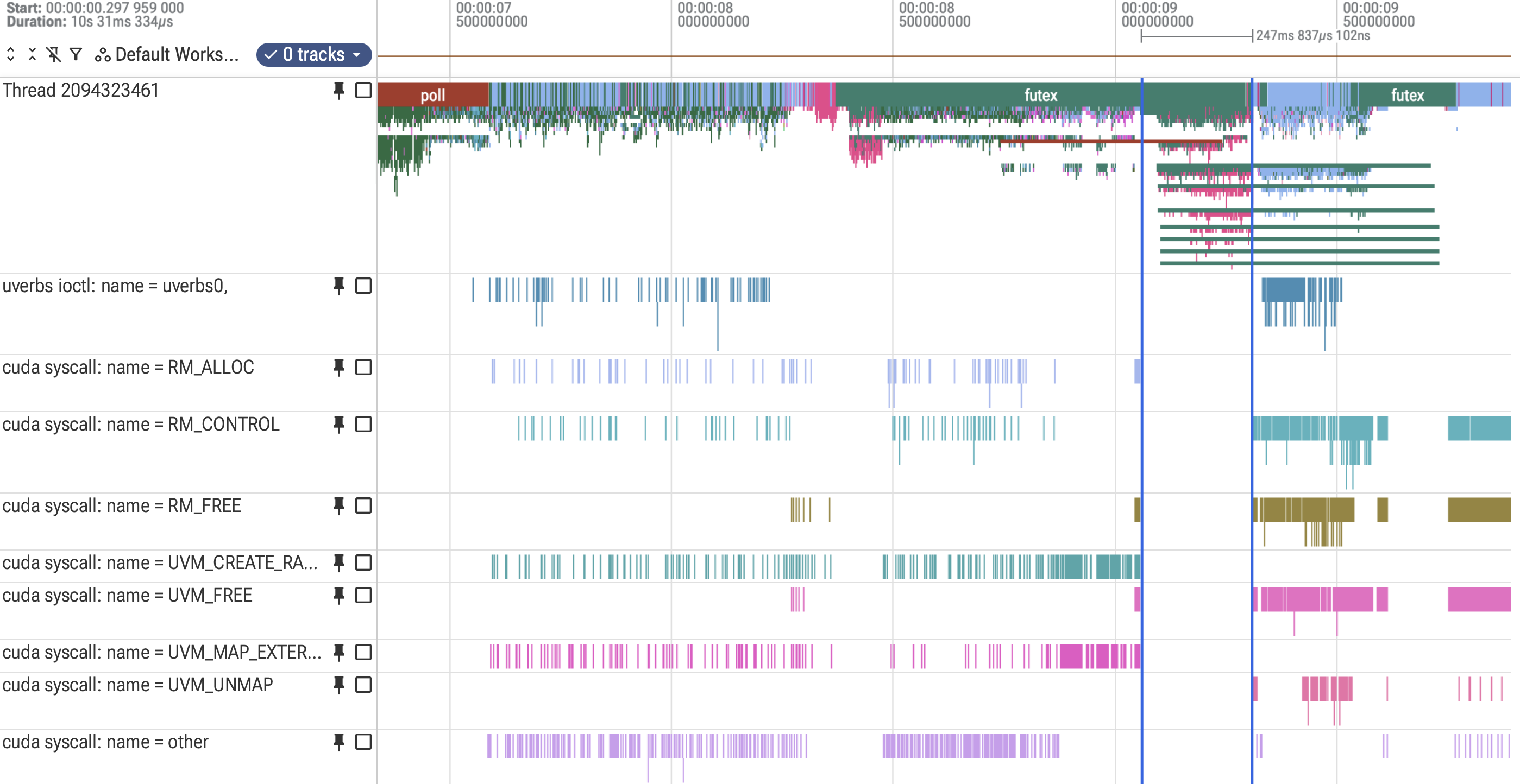
uverbs ioctl() calls, and CUDA calls. RM_ALLOC is called in the first group of uverbs ioctl() calls but not in the second group, hinting that all 50 trials executed during the ~250ms gap in uverbs/CUDA ioctl() calls.Results
Below are benchmark results for the RDMA implementation on instance types from various cloud providers. All metrics matchrunc performance 1:1 within a couple of Gbps of variance. | Instance Type | Busbw | Algbw |
|---|---|---|
| Crusoe B200s7 | 873.1 Gbps | 465.7 Gbps |
| Oracle B200s | 5536.8 Gbps | 2953.0 Gbps |
| GCP B200s | 4931.7 Gbps | 2630.3 Gbps |
| Whitefiber H200s | 3836.4 Gbps | 2046.1 Gbps |
1. Mounting RDMA files from
sysfs in the container2. Supporting DMABUF in
nvproxy3. Adding
RDMAProxy interface and plugin for Mellanox ConnectX devicesI predict that RDMA network cards will continue to increase in bandwidth, and my hope is that hardware production expands across multiple manufacturers. Google is partnering with Intel to manufacture custom NICs for their TPUs. gVisor is already working on supporting Falcon hardware, which is very exciting!
I want to thank the team at Modal who collaborated with me on this project: Ayush Ranjan, the gVisor maintainer, and Peyton Walters, my internship mentor. Thank you Ayush, Erik Dunteman, Marmik Chaudhari, Abinaya Dinesh, Ben O'Keefe, and Rahul Chalamala for providing helpful feedback on this post.